
Safe Harbor
The harbor is not the destination. It never was.

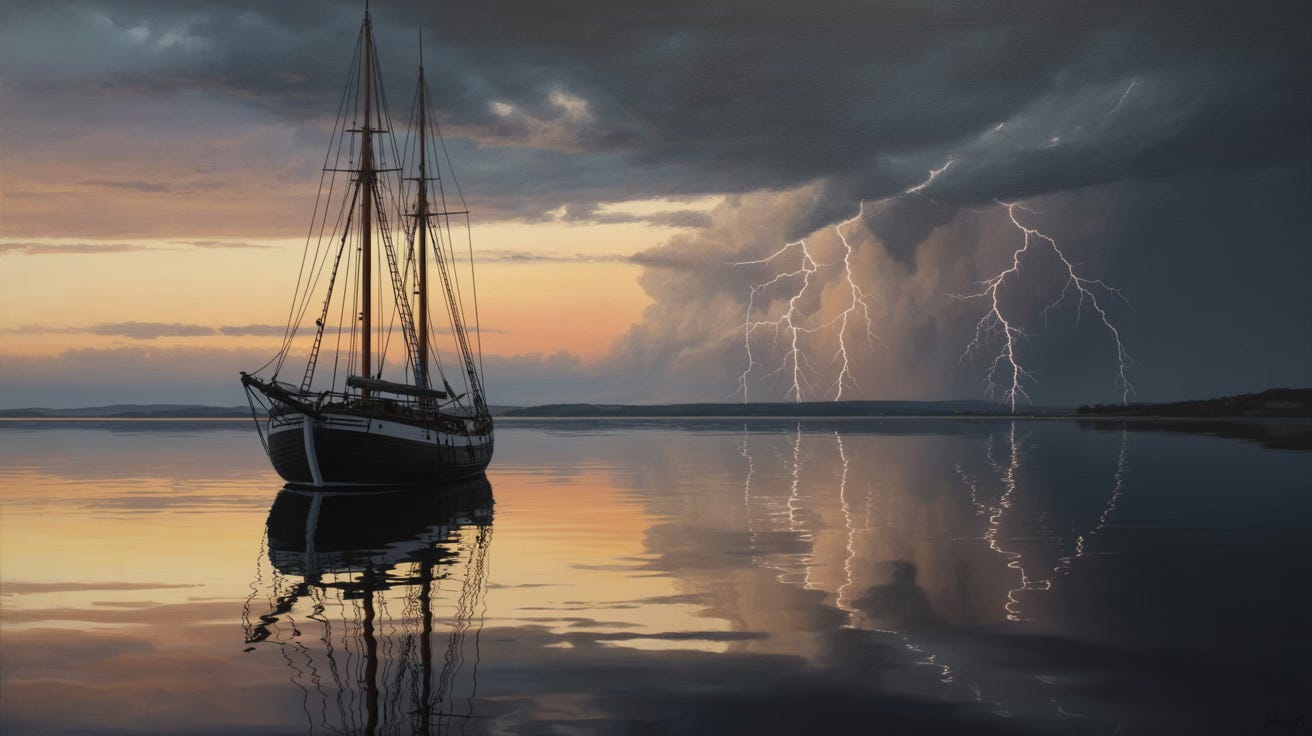
Sarah McLachlan’s Angel is a song about exhaustion. Not the kind that sleep fixes — the kind that accumulates quietly in the soul, the weight of being alive in a world that doesn’t pause for you to catch your breath. The angel in the song isn’t salvation. It’s a moment of rest. A harbor.
That distinction matters.
I know a man in his eighties who has been fighting a slow, relentless war for thirty years. Not on a battlefield — though he fought on one of those too, long ago, in a jungle far from home. This war has been quieter, more private, waged inside his own body. He has never made much of it. He does not complain. He simply continues, day after day, with a kind of dignity so understated you could almost miss it.
He is losing now. Not to surrender — he doesn’t know how. Simply to time, and to the math of a body that has given everything it had.
He is where this began.
A harbor is not a destination. Ships don’t retire there. It’s a place to repair what the storm damaged, to recharge, to wait out the weather — and then return to the sea. The sea that will, inevitably, produce another storm.
That’s not a tragedy. That’s the deal.
Tennyson’s Ulysses understood this. In the poem, he has made it home to Ithaca, to comfort, to safety — earned his rest by any measure. And yet:
I cannot rest from travel; I will drink life to the lees.
He chooses the sea again. Aging and aware of his own mortality, knowing the next voyage may be his last — he chooses it anyway. Not out of recklessness, but because to stop, to let the harbor become the whole world, is its own kind of death. “To strive, to seek, to find, and not to yield.” The harbor restored him. It was never meant to contain him.
That’s what perseverance actually looks like. Not the absence of wounds, but the willingness to return to what caused them — because the alternative is to have stopped living before you’ve died.
I think about my children when I write this. They are inheriting a world with serious problems — problems that did not begin with them and will not end quickly. The weight of that is real. I don’t dismiss it or minimize it. There will be storms they face that I cannot fully imagine from where I stand.
But I want them to know what I have seen.
I have watched my uncle fight, quietly and without fanfare, for thirty years — a war inside his own body, waged without complaint, without surrender. I have watched my own parents move through the difficulties of their lives with a steadiness I didn’t always recognize as strength when I was young, but do now. They are simply always there — not because life is easy, but because being there is what you do.
And before them, my grandparents. Immigrant families on both sides, who came to this country and built their lives from the ground up — without glamour, without guarantee. A man who rose before dawn for decades to deliver milk door to door. A woman whose hands moved steadily through years at a sewing machine in a garment factory, stitching fabric, answering the same bell for thirty years. A grandfather who laid stone as a mason and served his country when called. The first in his family — and the only one among his siblings — to earn a college degree, at a time when poor immigrants’ sons rarely did. A grandmother who also served — putting on an Army uniform toward the end of the Second World War, at a time when few women were asked, and fewer still stepped forward. None of them made a point of it. None of them asked to be admired. They simply kept going — through hardship, through exhaustion, through the full weight of their lives. They showed up. That was the point.
I have watched what it looks like to keep showing up — not because the sea calmed down, but because showing up was the whole argument. And I want my children to understand.
This is not ancient history. This is your blood. This is what you are made of.
The harbor is real. Rest is necessary. There is no weakness in finding shelter when the storm is at its worst — only wisdom. Take the rest. Let it restore what has been worn down. Let someone say I see you and let that be enough for a moment.
And then go back out.
The living don’t get to stay in the harbor. While you are alive, the sea is yours. The fight continues until it cannot. As Dylan Thomas wrote — You do not go quietly into that good night.
Rage, rage against the dying of the light.
There is one more thing, older than all of this.
We are organic matter — assembled from the earth, running on borrowed time, and eventually returning to what made us. The same atoms in your bones have been in stars, in dirt, in ten thousand living things before you. Death is not an ending so much as a transition of form. The universe wastes nothing.
Which means the fight itself — every act of perseverance, every return to sea after the harbor — is part of that cycle. The energy spent surviving becomes part of what the world is made of. You are both of this earth and in it. That is not a metaphor. It is physics.
My uncle understands that, I think, without ever needing to say it. So do my parents. So did the immigrants who crossed an ocean with nothing but nerve, and the milkman who rose before the sun, and the seamstress whose hands never stopped moving. They all lived it — in their bones, in their hearts, in the quiet mornings where they chose, again, to continue.
That perseverance is not lost when they are gone. It passes forward. It is in you.
It does not yield.
To strive, to seek, to find, and not to yield.
“The same atoms in your bones have been in stars, in dirt, in ten thousand living things before you. Death is not an ending so much as a transition of form. The universe wastes nothing.”
A truth, beautifully said. Thank you for this.