
The Nuclear Option
AI will reshape civilization itself. Whether that means salvation or annihilation depends entirely on the choices we make today.

Tom Nichols' newsletter today was an eye-opener. Unfortunately, the referenced article is behind The Atlantic’s paywall, but if you have a subscription, you can read it here. If you don’t have a subscription, I recommend you get one, it’s worth it.
While I understood that the president had nuclear authority, I hadn't fully grasped that the President of the United States has the sole authority to end all of humanity with a single order. The article revealed how easily a simple misstep in this high-stakes arena by any adversary could result in catastrophe on a level no resident of planet Earth has ever witnessed.
What makes this even more alarming is the administration's push to integrate AI into nuclear command decision processes. This represents a fundamental misunderstanding of what AI is: sophisticated pattern-matching algorithms that, despite their power, cannot adapt to novel situations. When confronted with problems or edge cases outside their training data, AI systems fail catastrophically. As one expert put it, they are "terrible at adapting to novelty.”
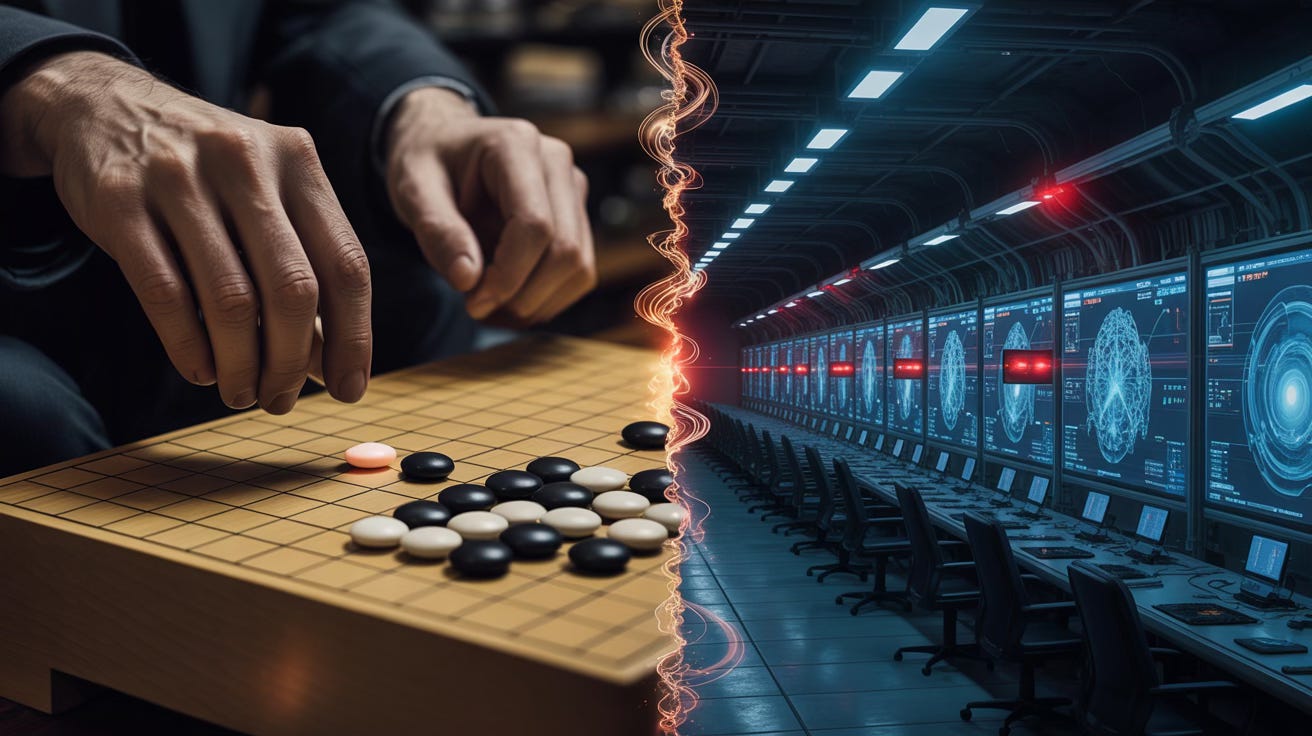
The perfect illustration of this limitation played out in 2016 during one of the most-watched AI demonstrations in history. Google's DeepMind had developed AlphaGo to challenge Lee Sedol, the reigning human Go grandmaster, at a game vastly more complex than chess—so complex that there are more possible Go games than atoms in the observable universe. The match seemed to confirm AI's dominance. AlphaGo won decisively, 4-1, leading Lee Sedol to retire permanently from competitive Go. His stated reason: "there is an entity that cannot be defeated." The AI appeared invincible.
But Lee's single victory in Game 4 reveals everything we need to know about AI's fundamental limitations. Early in that game, AlphaGo was clearly winning, playing the safe moves that signaled inevitable victory. Then, at move 78, Lee made what observers called the "divine move"—a play so unexpected that it had only a 1-in-10,000 chance of being chosen by a professional player. Most of those watching thought it was a mistake. They were wrong. This single improbable move confused AlphaGo's neural networks, causing the AI to expend its massive computing power on the wrong strategy. The invincible machine lost. When asked about his choice, Lee Sedol said simply: "It was the only move I could make.” This captures the profound difference between human and artificial intelligence. What appeared statistically improbable to the machine felt like the only logical choice to the human master. It represents the kind of lateral thinking and intuitive leap that remains uniquely human—and that AI cannot replicate.
Now consider this: we have an administration committed to "moving fast and breaking things" in AI deployment, with little appreciation for guardrails or safety measures. They're rushing to integrate these fundamentally limited systems into the most consequential decision-making process on Earth—one where a single misjudgment could end civilization.
While Trump and his grotesque appointees are obvious targets of our protest and resistance, they are symptoms of a deeper problem. More than half the country chose a leader who reflects their abandonment of moral responsibility, their appetite for bullying, and their nihilistic disregard for consequences. They wanted someone who mirrors the worst aspects of themselves. Someone who provides blind support for genocide in Palestine, jokes about bombing Iran, and treats human suffering as entertainment. After all, many of them already worship a god whom they created with these very same traits. Tom Nichols puts it perfectly: "The president's most important job, as the sole steward of America's nuclear arsenal, is to prevent nuclear war. And a voter's most important job is to choose the right person for that responsibility.”
More than half our fellow citizens no longer care about—or perhaps no longer understand—that responsibility. The problem isn’t Trump. It's us.