
What Birds Know
We visit the sky. Birds live there. Here's what I learned about flight from a hawk that crossed my path at 1,500 feet.

From the 20th floor of my apartment building, I looked out over a late-winter Virginia cityscape. I was not really present. I had just gone through my morning news feed and was thinking about the multiple tragedies the world seems to be rapidly accelerating towards. There is a lot to be angry and sad about, most of which has been caused directly by humans or through our indifference to the world we are part of.
I absently take another sip of hot coffee—a beverage I often use to ease my anxiety. Then I notice a couple of crows slipping smoothly through the cold morning air, and something shifts. My mind drifts back to another morning, years ago, when I was working on my pilot’s license. Funny how a bird in flight can pull you across decades in an instant.
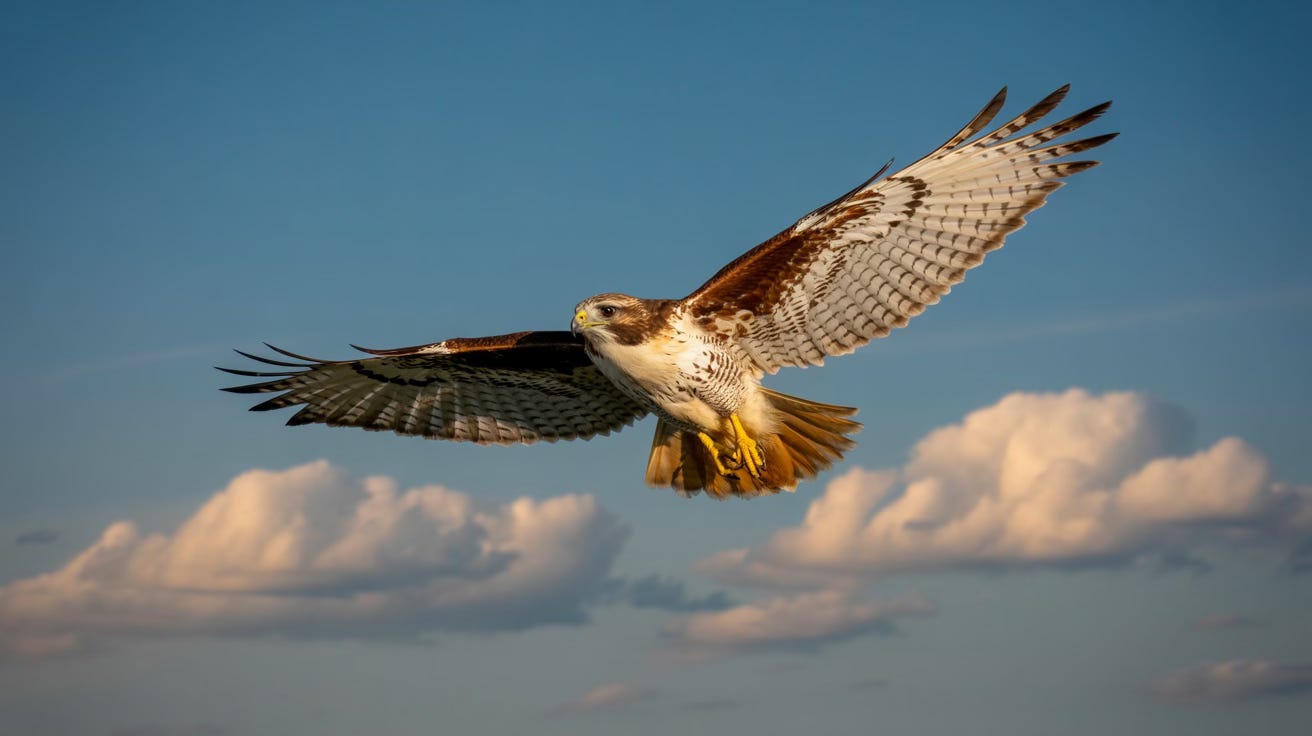
The hawk appeared at my two o’clock, maybe five hundred feet below, riding the thermal I’d just climbed through. I banked gently to keep it in sight, feeling the Cessna’s response through the yoke—that familiar translation of intent through cables and control surfaces, filtered through sheet metal and Plexiglas. The hawk didn’t think about flying any more than you think about breathing. My Cessna needed power to climb, fuel to stay aloft, and constant attention to airspeed and coordination. The hawk simply was there, its wingtips adjusting in ways I could see but never truly understand. Not with ailerons and rudder, not with conscious thought about coordination or adverse yaw. Its body simply curved into the turn, each feather reading the air, making a thousand micro-adjustments my instruments and brain would never register.
By then, I’d spent about sixty hours learning to keep this aluminum machine from killing me. Stalls, steep turns, emergency procedures. I’d memorized V-speeds and learned to feel the break in airflow over the wing through the controls’ gentle buffet. The numbers came without thinking: best glide speed, crosswind correction, when to add carb heat. On good days, the plane became an extension of will—I think “turn” and my hands and feet make it so before I’m aware of moving them.
I was competent by then. Maybe even good. But I flew with my hands, feet, eyes, and the seat of my pants. The hawk flew with its blood and marrow and breath.
Those hollow bones felt pressure changes I could only infer from the altimeter’s lazy needle. When it banked, the turn wasn’t a mechanical compromise between lift and gravity, calculated and executed. It was a conversation with the wind, spoken in a language I could not hear. Watching that hawk, I felt something I still can’t name. It wasn’t envy, exactly, though that was part of it. It was something like grief for an experience I could never have, mixed with gratitude that I could at least witness it.
The hawk rolled inverted for no reason I could discern—not hunting, not evading, just... playing, perhaps? Testing some eddy in the air that my instruments would never show? It hung there for a heartbeat, then folded into a dive. I felt my own dive through the controls’ resistance, through the airspeed indicator’s climbing needle, through the wind noise changing pitch. The hawk felt it in its bones, in every surface of its body in direct contact with the air itself.
I pulled power and descended, trying to follow, knowing it was pointless. The hawk wasn’t going anywhere I could chase it. It lived in three dimensions in a way I never would, no matter how many hours I flew or how smooth my landings became.
By the time I turned to final and set up for landing—GUMPS check, radio calls, airspeed over the threshold—the hawk had vanished over the ridge. My touchdown was decent. The stall horn chirped at exactly the right moment. The mains gently kissed the pavement, and I held the nose wheel off until it settled on its own.
Everything by the numbers. Not bad. My instructor would have approved.
As I tied down the wings, another bird—a crow, this time—caught an updraft off the hangars and spiraled upward without a single wingbeat. I stopped to watch it climb, my hand still on the tiedown rope, and felt that feeling again. I stood there until the crow was just a speck against the clouds, my paperwork forgotten in the cockpit, still trying to find a word for what I felt.
Maybe this is what it means to be a pilot: to know enough about flight to understand exactly what you’re missing. To see the sky through a windscreen and realize that for all our machines and ambition, we’re only ever visitors. Birds don’t conquer the sky. They live there. And that’s something no pilot will ever do, no matter how many hours we log or how smooth our landings become. We visit. They belong.
But even a visited sky is better than a sky only dreamed of. And maybe, in those rare moments between earth and heaven, when everything aligns, when the plane becomes an extension of intent rather than a force to be managed—maybe then we brush against something that birds know in their bones.
Maybe that’s enough.
Back on the 20th floor, my coffee has gone cold. The crows are long gone, but I’m still watching the empty sky where they were, still feeling that unnamed thing. Some experiences you only get to witness. But witnessing, I’ve learned, is its own kind of grace.
This piece was inspired by Chloe Hope’s Death & Birds on Substack. If you haven't discovered her writing yet, you're missing something rare—words that come from the heart and stay with you long after you've read them. Her work makes the world better, at least in the small corner where I live.
This was riveting. Intimate and vivid. I felt this, in particular: “It wasn’t envy, exactly, though that was part of it. It was something like grief for an experience I could never have, mixed with gratitude that I could at least witness it.” Beautiful.
This is absolutely gorgeous, Ken. And thank you for your extremely generous words.